

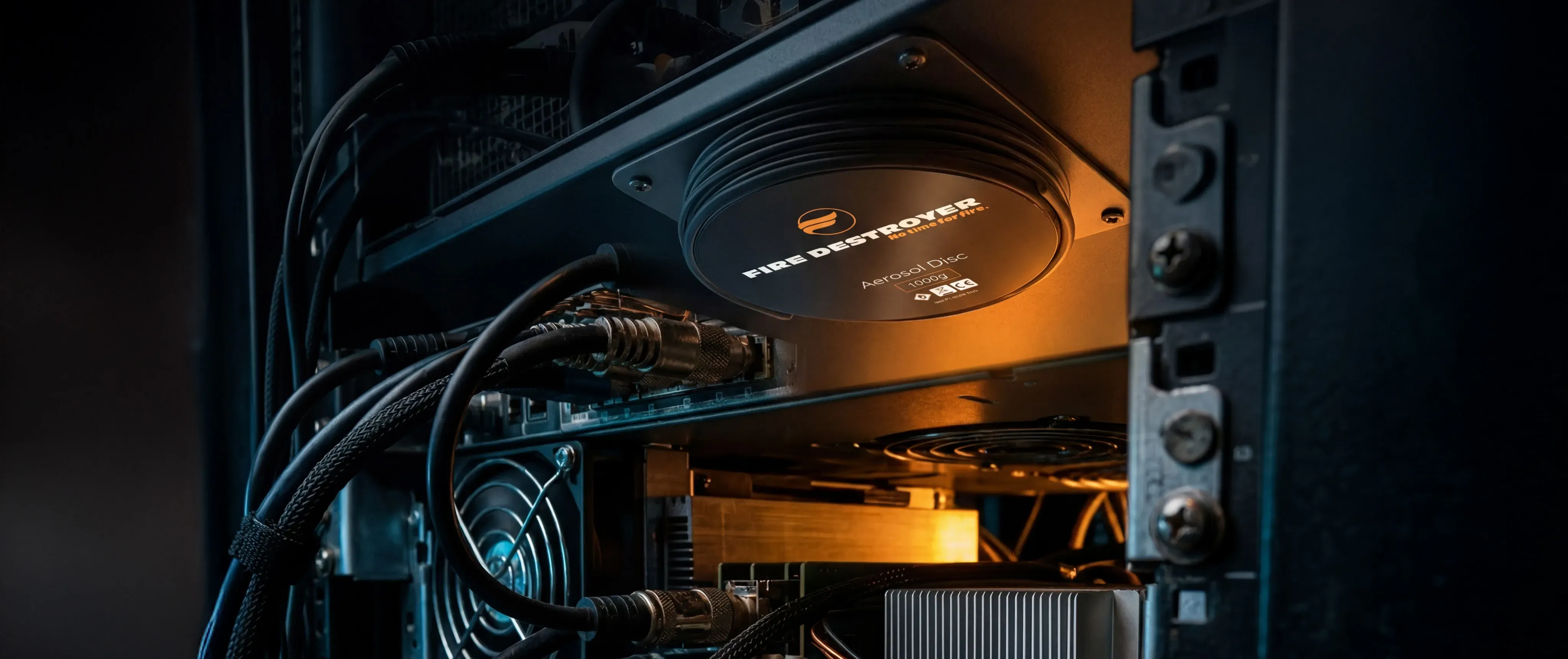
Fire Destroyer works automatically, quickly, and effectively
Active fire protection Fire Destroyer does not require human presence to activate the extinguishing process. Upon first contact with a flame, it activates automatically, releases harmless powder or gas, and extinguishes the fire. The extinguished area is easy to clean.THE BASICS
Simple and effective
Fire Destroyer replaces complex fire suppression infrastructure with a single, autonomous device placed exactly where fires start.
1
Mount near the risk
Mount near the risk
Mount a Fire Destroyer device directly at the potential ignition point, inside an electrical panel, above machinery, in an engine bay. Installation takes 1–15 minutes. No wiring or plumbing.
2
Flame reaches the fuse
Flame reaches the fuse
When fire breaks out, the flame reaches the device and triggers a thermal fuse. Within 3–5 seconds, the self-activation mechanism fires. No batteries, sensors, or power supply needed.
3
Fire gets suppressed
Fire gets suppressed
A non-toxic extinguishing agent, aerosol or dry powder, disperses rapidly through the enclosed space, suppressing the fire across classes A, B, C, and F before significant damage occurs.
4
Flame In. Fire Out. In Seconds.
Flame In. Fire Out. In Seconds.
The fire is stopped at its earliest stage, keeping the surrounding area safe and preventing further damage. Equipment, property, and critical systems remain protected, allowing for a quick return to normal operation with minimal disruption.
THE ANATOMY OF A FIRE
Why speed matters
Damage
Time
HEATING

SMOKE PARTICLES
SMOKE

FIRE IGNITION
FIRE DEVELOPMENT
FULL FIRE
NFRARED SYSTEMS
SMOKE ASPIRATION SYSTEMS
SMOKE DETECTORS
FLAME DETECTORS
SPRINKLES
FIREFIRGHTERS
Effective across all major fire classes
Solid materialsWood, paper, textiles, and plastics are the most common combustibles in any environment.
Flammable LiquidsPetrol, diesel, solvents, oils, and paints are critical in industrial and automotive settings.
Flammable GasesNatural gas, propane, butane, and hydrogen are present in heating systems and industrial processes.
Cooking OilsDeep fryer oils and kitchen grease are common in commercial and residential kitchens.
SIDE BY SIDE
Fire Destroyer vs. Traditional systems
'%20stroke-width='2'/%3e%3cdefs%3e%3clinearGradient%20id='paint0_linear_617_1141'%20x1='15.1345'%20y1='0.460938'%20x2='15.1344'%20y2='545.731'%20gradientUnits='userSpaceOnUse'%3e%3cstop%20stop-color='%23E2DED8'%20stop-opacity='0'/%3e%3cstop%20offset='0.2'%20stop-color='%23E2DED8'/%3e%3cstop%20offset='0.8'%20stop-color='%23E2DED8'/%3e%3cstop%20offset='1'%20stop-color='%23E2DED8'%20stop-opacity='0'/%3e%3c/linearGradient%3e%3c/defs%3e%3c/svg%3e)
'%20stroke-width='2'/%3e%3cdefs%3e%3clinearGradient%20id='paint0_linear_617_1142'%20x1='15.022'%20y1='0.460937'%20x2='15.022'%20y2='545.731'%20gradientUnits='userSpaceOnUse'%3e%3cstop%20stop-color='%23E2DED8'%20stop-opacity='0'/%3e%3cstop%20offset='0.2'%20stop-color='%23E2DED8'/%3e%3cstop%20offset='0.8'%20stop-color='%23E2DED8'/%3e%3cstop%20offset='1'%20stop-color='%23E2DED8'%20stop-opacity='0'/%3e%3c/linearGradient%3e%3c/defs%3e%3c/svg%3e)
| Fire Destroyer | Traditional extinguisher | Sprinkler system | |
|---|---|---|---|
| Self-activating | |||
| Meintanence required | None for 3‒5 days | Annual inspection | Every 6 months |
| Instalation time | 1-15 minutes | 15 minutes | Days to weeks |
| Requires power | No | No | Varies |
| Response time | 3‒5 sec from flame contact | Depends on person | 70°C at ceiling level |
| Water damage risk | None | None | High |
| Portable | |||
| Alarm on activation | Up to 120 dB | ||
| Installation cost | Low | Low | High |
| Warranty | 3‒5 years | 1 year | 1-5 years |

Advantages of fire destroyer devices
- Ball: You simply throw the ball into the fire or position it in a place at risk of fire.
- Sticker: Attach the sticker to a place where access is restricted.
- Disk: Due to its shape, the disk, product for vehicles and vessels, is simply placed next to the engine or other dedicated space, thereby protecting your property as a preventive measure in the event of a fire.
- Metal sticker: Simply attach the tile to a cleaned and degreased surface or screw it into place.
- Sticker: Attach the sticker to a place where access is restricted.
- Disk: Due to its shape, the disk, product for vehicles and vessels, is simply placed next to the engine or other dedicated space, thereby protecting your property as a preventive measure in the event of a fire.
- Metal sticker: Simply attach the tile to a cleaned and degreased surface or screw it into place.

Ready to protect your facility?
A Fire Destroyer unit costs a fraction of a single day's production downtime.